The Colony
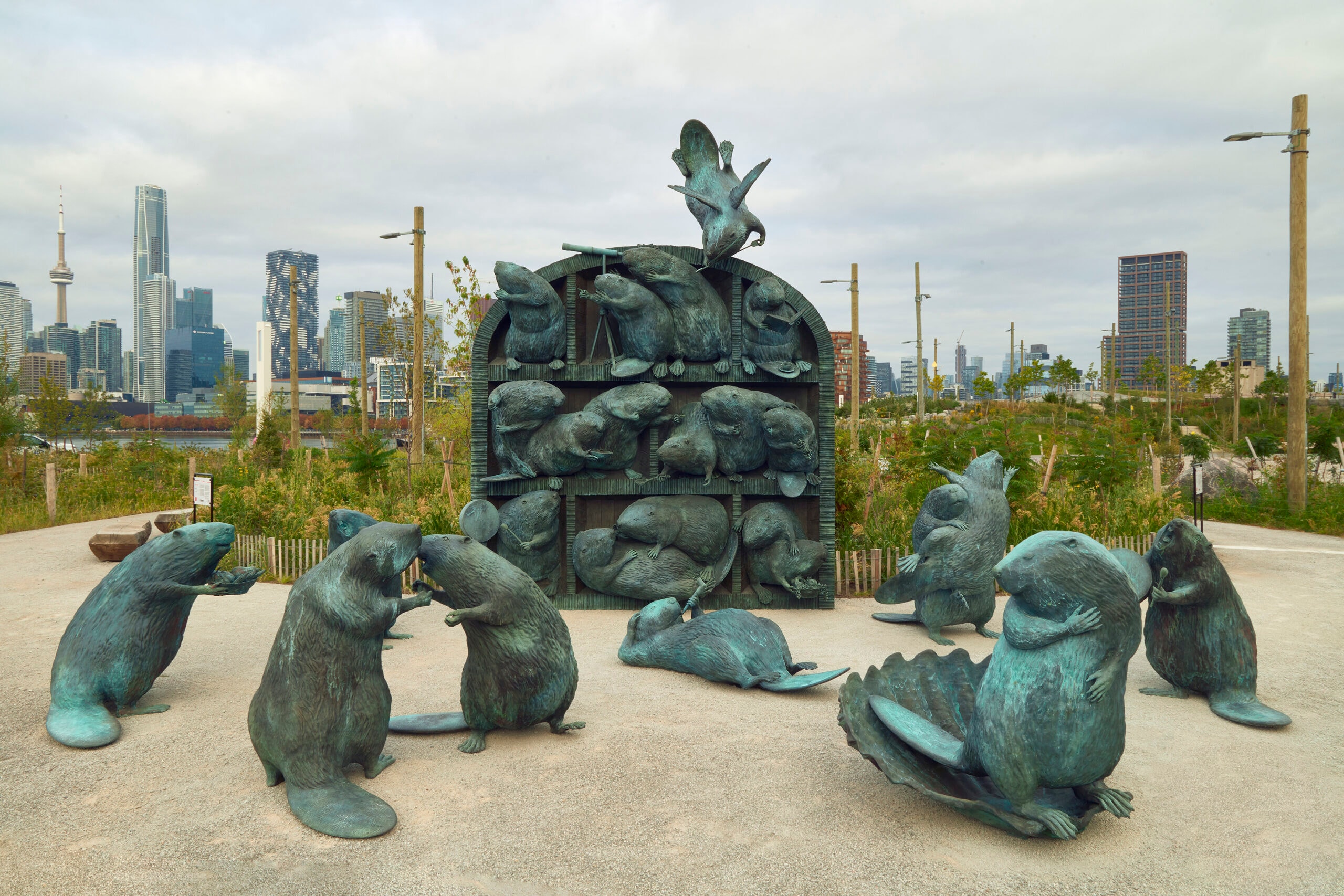
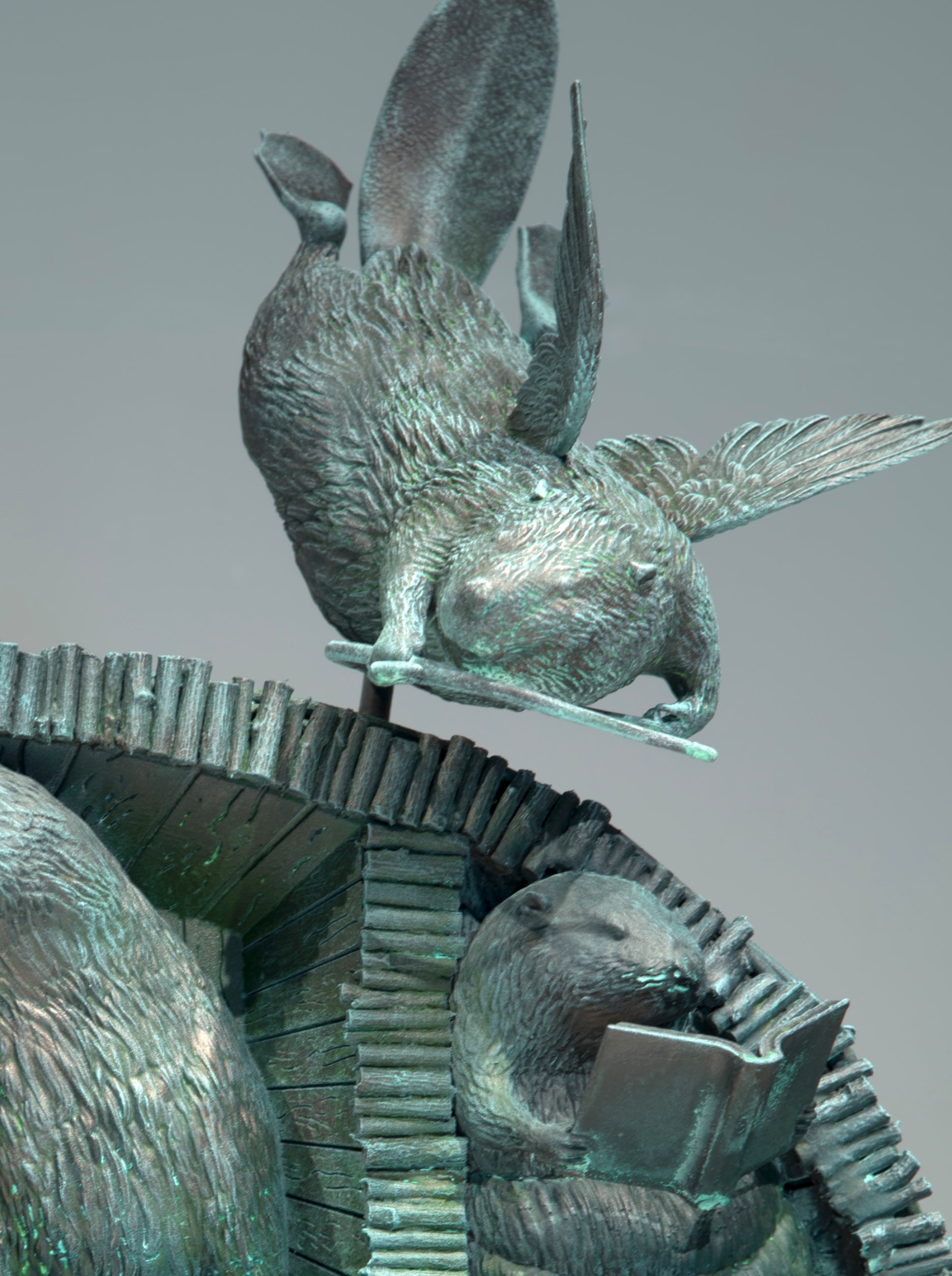
The Colony by Kent Monkman. Courtesy of the artist. Photo: Michael Seleski.
The Colony, 2026
Kent Monkman
Bronze, steel
Permanent
Against the backdrop of Toronto’s densely packed modern glass and steel condominiums, an over 15-foot tall bronze beaver lodge rises sumptuously on the shores of a new waterfront parkland on the new island of Ookwemin Minising: Biidaasige Park. The larger-than-life lodge centrepiece, turquoise patina, and the encircling twisting Rococo and Baroque figurations of oversized beavers—feasting, singing, dancing, and celebrating—evoke Indigenous ceremonies as well as the opulent sculptures of the gardens at Versailles. In The Colony, Cree artist Kent Monkman invites the viewer to ponder the essential role that Castor canadensis played in colonial power struggles for this continent, and the enduring importance of beavers to ecosystems on Turtle Island.
Beavers are relatives in Indigenous kinship networks, and stories of mistahi-amiskwak—the giant beaver forebears of Castor canadensis—feature in Cree narratives of the past. In The Memoirs of Miss Chief Eagle Testickle, written by Monkman and his collaborator Gisèle Gordon, Monkman’s alter-ego Miss Chief recalls the historical world of beavers: “I had known his ancestors—the mistahi-amiskwak—kayâs, long ago. The amiskwak were an ancient people. They were a vast nation that spread across miskinâhk-oministik [Turtle Island] from coast to coast. In the east they lived in opulent multi-tiered lodges and had bustling villages that numbered in the millions.”
Before the 17th century, when the Indigenous trade of beaver pelts on Turtle Island began to supply the voracious demand for felt hats in Europe, the beaver population numbered in the hundreds of millions. The common beaver became the first currency exchanged between Indigenous people and European settlers, its pelt coveted and fought over by competing colonial forces and venture capitalists all vying for economic and political dominion of Indigenous land, trade routes, and waterways. By the 18th century, the beaver became central to the struggle between the French and the English for dominance in New France.
The numerous and expensive wars that France fought in the 18th century resulted in a distracted King Louis XV, who was also obsessed with hunting exotic animals in foreign lands. New France fell to the British during the reign of Louis XV, and some commentators have speculated that it was his love of the hunt that preoccupied him when he should have been more attuned to the geopolitical ambitions of his nation.
Louis XV was also an extravagant spender who pushed his country to the brink of bankruptcy. One of his extravagancies was the Gallery of Hunts in Foreign Lands—also known as La Petite Galerie du Roi—that he built at Versailles as an indulgent homage to his favourite pastime. He commissioned nine paintings of hunting scenes depicting exotic animals by various artists including François Boucher and Nicolas Lancret. Notably absent from this series, however, are paintings that represent the hunt of wild animals on Turtle Island, such as the beaver. Like much of Monkman’s work that explores and suggests missing narratives from art history, it is this omission that offers some inspiration for Monkman’s sculpture, The Colony.
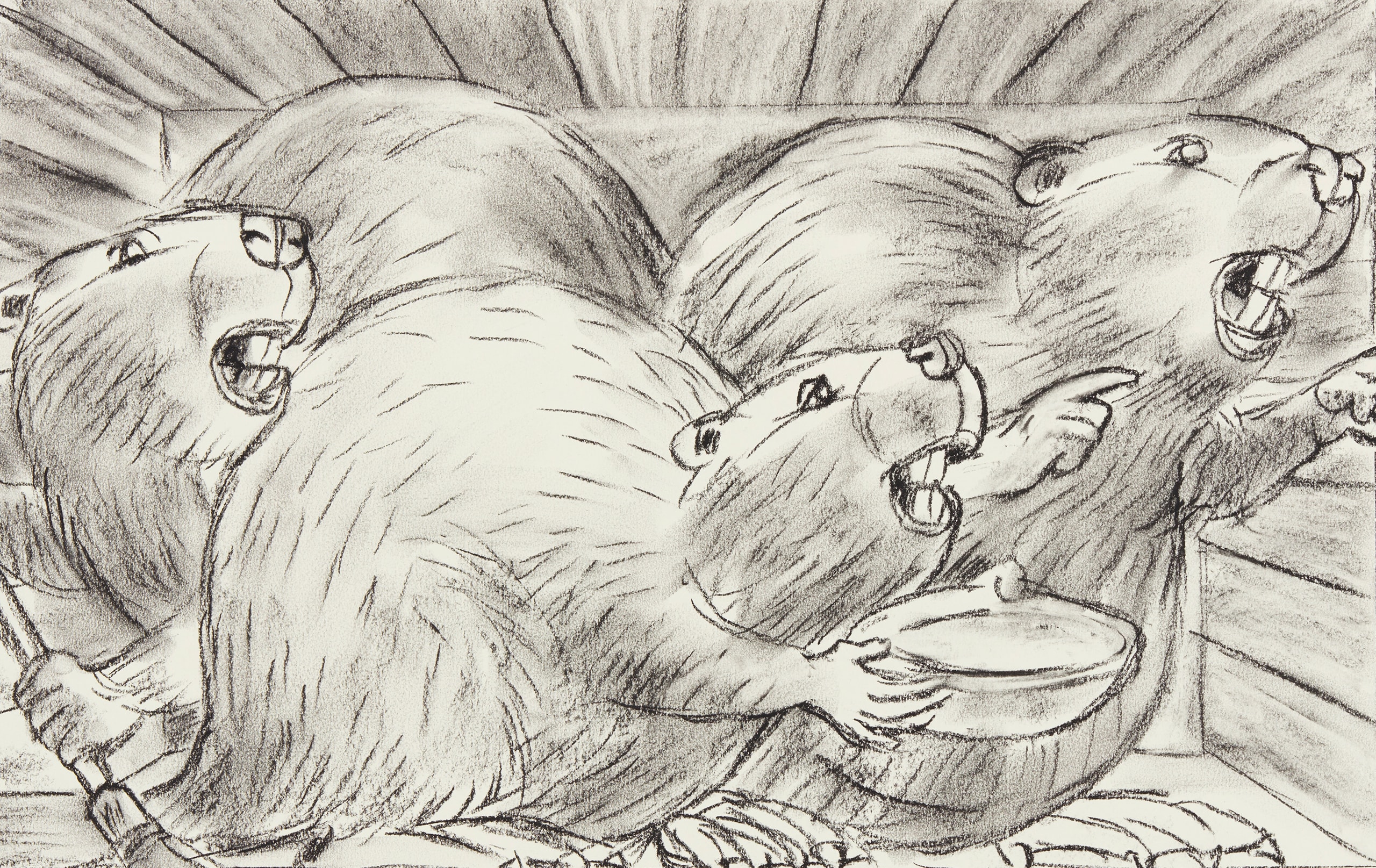
The sculpture evokes the fanciful and wicker-like beaver lodge depicted in Italian artist Veremondo Rossi’s 1763 engraving La Caccia Dei Castori. In this illustration for an encyclopedia of North America aimed at European audiences. Rossi depicts the beaver as a quirky, intelligent animal with anthropomorphic characteristics. These human qualities are exaggerated in The Colony, with Monkman’s beavers embodying a variety of mythological subjects and bacchanal scenes from art history. The condo-esque, compartmentalized lodge in The Colony acquires new implications when set in the modern urban environment of Toronto. Gathered inside and outside the lodge, the beavers celebrate the nearby water in a ceremonial feast, upholding the importance of water in Indigenous worldviews and referencing the Cree practice of transmitting scientific knowledge through songs and stories.
The North American fur trade dwindled during the 19th century, and by the turn of the 20th century the beaver population had dropped to 100,000. In modern times, the common beaver has been maligned as a nuisance animal for its habit of altering water courses.
However, Castor canadensis is becoming increasingly conspicuous in urban areas such as Toronto’s waterfront with the remediation of former industrial portlands such as Biidaasige Park. The human design-driven renaturalization of the Don River correlates with the ability of beavers to change the flow of water and leave a huge impact on their surrounding biome. Beavers are considered a keystone species, and the lodges, dams, canals, and ponds they construct have the potential to enrich local biodiversity, recharge groundwater reserves, offer protective refuges against forest fires for other wild animals and birds, lessen effects of drought, hinder flood flow speeds, reduce soil erosion, stow carbon, and purify stored water. Like humans, beavers are able to shape their environments and restore ecosystems, as Indigenous ways of knowing have long held. As beavers re-enter the urban environment and continue their work of damming, redirecting, and flooding—sometimes against the plans of human-centred ecological design—a question arises: who knows best?
Playful and inviting, the beavers of The Colony speak to complex histories as well as future possibilities.
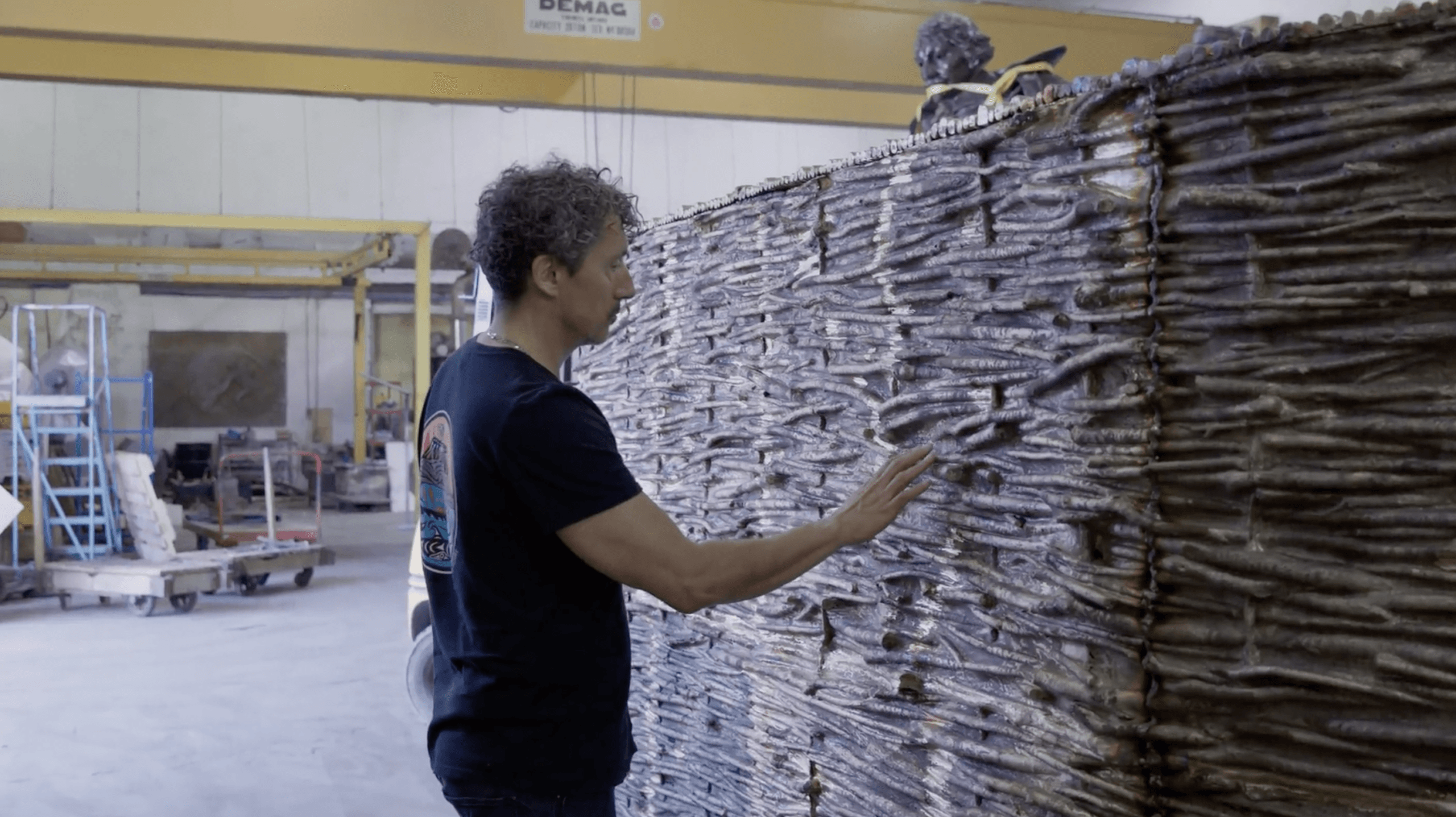
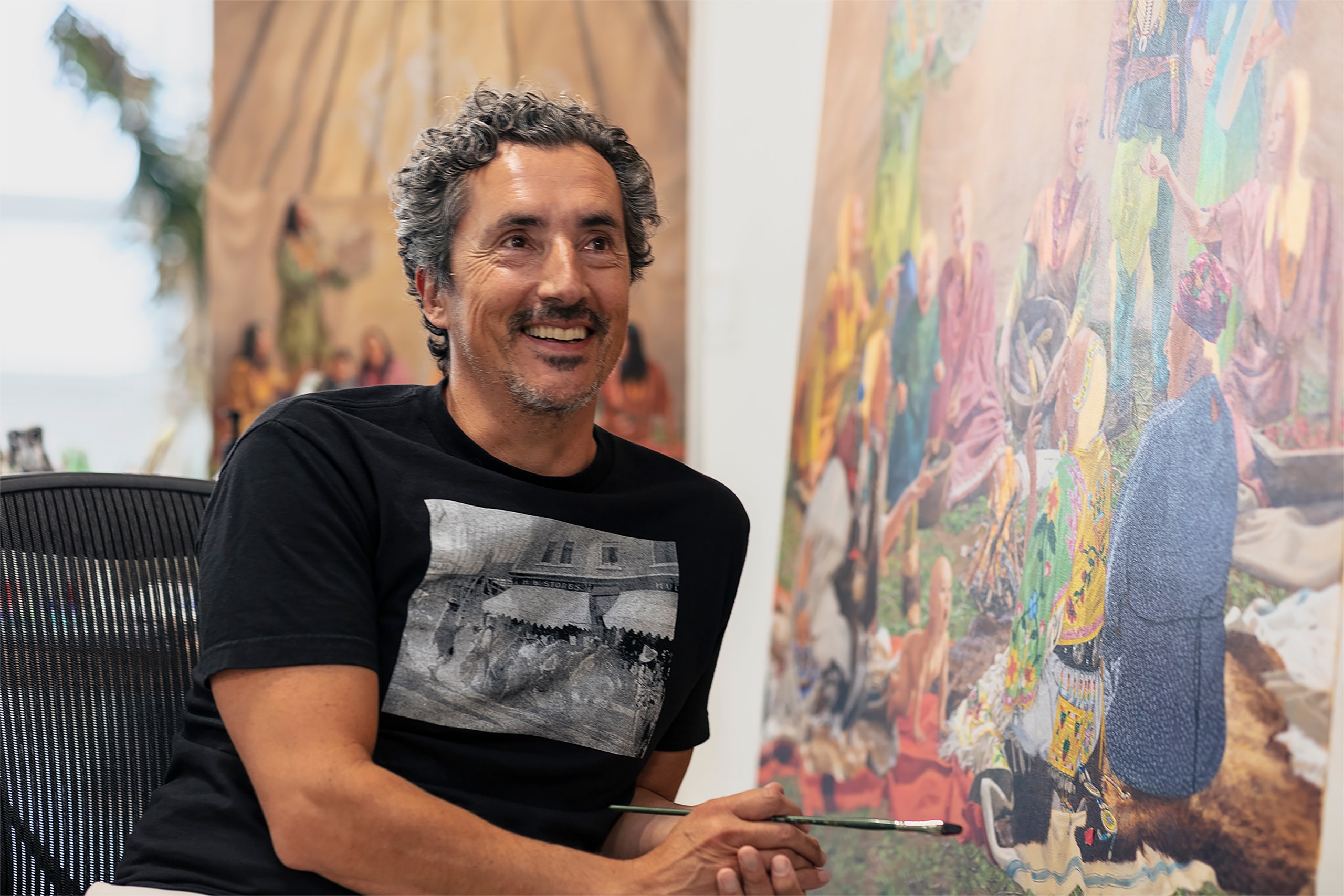
A behind the scenes look at Kent Monkman working at MST Bronze Limited - Art Foundry. Documentation by David Hartman.
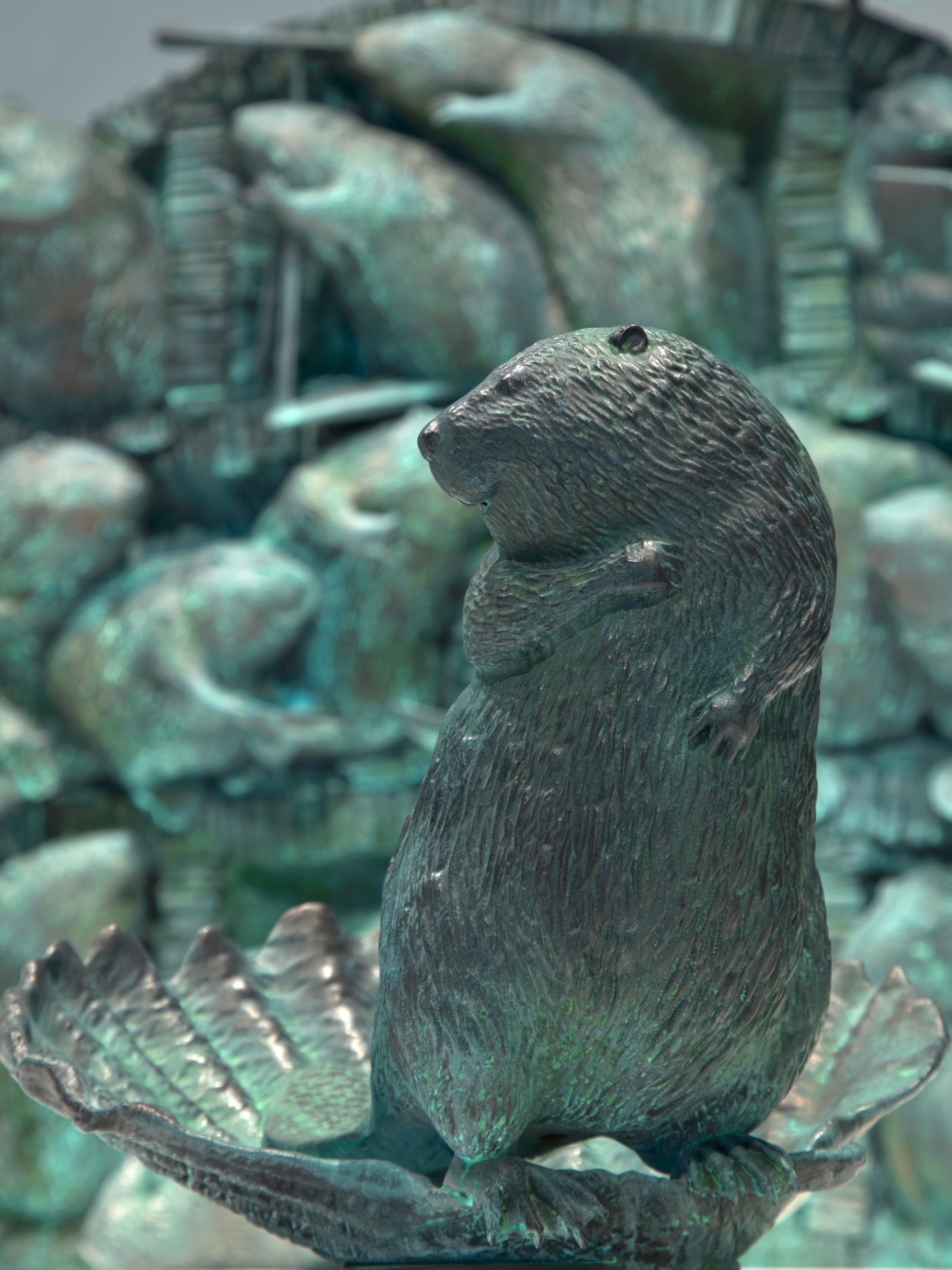
Photographs of the maquette for The Colony by Kent Monkman. Courtesy of the artist.

Kent Monkman
Cree
Kent Monkman is an interdisciplinary Cree visual artist. A member of Fisher River Cree Nation in Treaty 5 Territory, Manitoba, he lives and works between New York City and Toronto. Known for his thought-provoking interventions into Western European and American art history, Monkman explores themes of colonization, sexuality, loss, and resilience—the complexities of historic and contemporary Indigenous experiences—across painting, film/video, performance, and installation.
His artworks are held in the permanent collections of institutions such as the Metropolitan Museum of Art, NYC, New York; the Denver Art Museum, Colorado; the Hirshhorn Museum, Washington, D.C.; the Hood Museum of Art, Hanover, New Hampshire; the Heard Museum, Phoenix, Arizona; Musée des beaux-arts de Montréal, Québec; the Glenbow Museum, Calgary, Alberta; macLYON, France; and the Art Gallery of Ontario, Toronto. Private collections that house his works include Art Bridges, Bentonville, Arkansas; the Horseman Foundation, St. Louis, Missouri; the Tia Collection, Santa Fe, New Mexico; the Carl & Marilynn Thoma Foundation, Santa Fe, New Mexico and Dallas, Texas; Forge Project, Taghkanic, New York; the Gochman Family Collection, NYC, New York; the Sobey Art Foundation, Pictou County, Nova Scotia; and the Rob & Monique Sobey Foundation, Pictou County, Nova Scotia.
In 2019, Monkman was commissioned as the inaugural artist to make two monumental paintings for The Met’s Great Hall Commission project. In 2023, he was appointed an Officer of the Order of Canada—Canada’s highest civilian honour.
Portrait of Kent Monkman. Courtesy of the artist